

 English
 русский
 中文简体

A cooling tower rarely fails all at once. What often happens is quieter: the cold water temperature creeps up by a degree or two over a season, drift becomes v...
READ MOREOct 09, 2026
Content
In industrial cooling systems, water is both the most essential element and the most common source of operational problems. Scale, corrosion, fouling, and microbial growth can silently degrade cooling tower performance, drive energy consumption upward, and shorten equipment life. A well-designed cooling tower water treatment system addresses these threats in a structured way, protecting the cooling tower itself and every piece of equipment connected to it.
At Zhejiang Dongjie Cooling Tower Co., Ltd., we have spent decades engineering cooling towers for power plants, petrochemical facilities, metallurgical plants, HVAC systems, and other demanding applications. In this guide, we share what we have learned about water treatment from a cooling tower manufacturer's perspective: how it works, why it matters, and how the right cooling tower design can reduce your water treatment burden.
A cooling tower water treatment system is an integrated arrangement of technologies and practices that keep cooling water from becoming the weak link in your process. Its job is not simply to purify water. It is to maintain water chemistry within a range that preserves heat transfer efficiency, prevents deposit formation, minimizes corrosion, and controls biological activity, all while using water responsibly.
A complete treatment approach typically covers the full water cycle of a cooling loop:
Because a cooling tower operates as an evaporative system, it continuously interacts with the surrounding air. Dust, pollen, insects, and airborne micro-organisms find their way into the water. Combined with natural evaporation, which concentrates dissolved minerals, this means the circulating water is under constant chemical and biological stress. An effective water treatment system keeps that stress under control.
Every cooling tower water treatment program is designed around four categories of problems. They are distinct, but they are interrelated: scale traps dirt, which creates ideal conditions for corrosion underneath, while biological films reduce heat transfer and provide shelter for corrosive bacteria.
| Threat | Primary Cause | Consequence | Typical Control |
|---|---|---|---|
| Scaling | Calcium and magnesium hardness precipitating at elevated temperatures | Reduced heat transfer, plugged fill and spray nozzles | Scale inhibitors, softening, controlled cycles of concentration |
| Corrosion | Dissolved oxygen, low pH, or aggressive ions attacking metal surfaces | Leaks, equipment failure, unplanned downtime | Corrosion inhibitors, pH control, corrosion-resistant materials |
| Fouling | Suspended solids, dirt, and debris accumulating in the system | Blocked distribution nozzles, fouled fill, higher pressure drop | Filtration, side-stream filtration, proper fill selection |
| Biological growth | Warm water, nutrients, and sunlight supporting algae and bacteria | Biofilm, Legionella risk, accelerated corrosion | Biocides, biodispersants, reduced stagnant water areas |
The equipment design has a direct influence on how much treatment your water needs. For example, cooling towers with a large open basin that holds static water require more attention to biological control than designs that keep water in rapid motion.
The quality of makeup water determines how heavily the rest of the program must work. Many facilities pretreat makeup water with softeners or reverse osmosis to reduce hardness, silica, and other dissolved solids. The cleaner the makeup water, the higher the permissible cycles of concentration, and the less water the system discharges.
Chemical treatment is the centerpiece of most water treatment programs. Scale inhibitors, corrosion inhibitors, and biocides are dosed into the circulating water according to a plan built around your water quality and system characteristics. The goal is to maintain stable chemistry within control limits rather than to shock the system periodically.
Blowdown is the deliberate discharge of a portion of the circulating water to control dissolved solids. Without blowdown, minerals concentrate beyond safe limits. A good blowdown strategy uses conductivity-based controllers to discharge only when necessary, saving water and protecting the system at the same time.
No water treatment program can succeed without measurement. Parameters such as pH, conductivity, turbidity, temperature, and biocide residual should be monitored on a schedule matched to the risk profile of the system. Continuous online sensors are valuable for larger installations, while reliable test kits remain a practical baseline for smaller plants.
As a cooling tower manufacturer, we want to emphasize a point that is often overlooked: the cooling tower itself is part of the water treatment system. Design choices such as material selection, flow arrangement, drift eliminators, and basin geometry either reduce or increase the treatment burden.
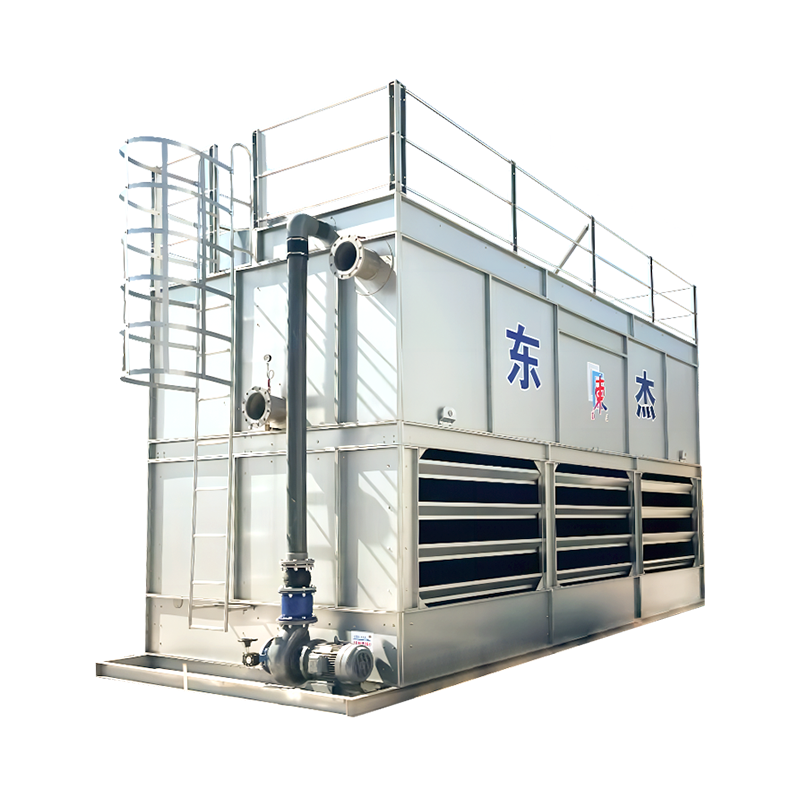
Consider the closed circuit cooling tower. Unlike an open cooling tower, a closed circuit design keeps the primary process water inside a sealed coil, while air and spray water cool the outside of that coil. Because the process water never touches the air, it does not pick up dust, algae spores, or airborne contaminants. This dramatically reduces the chemical treatment the process water requires and nearly eliminates biological contamination in the primary loop.
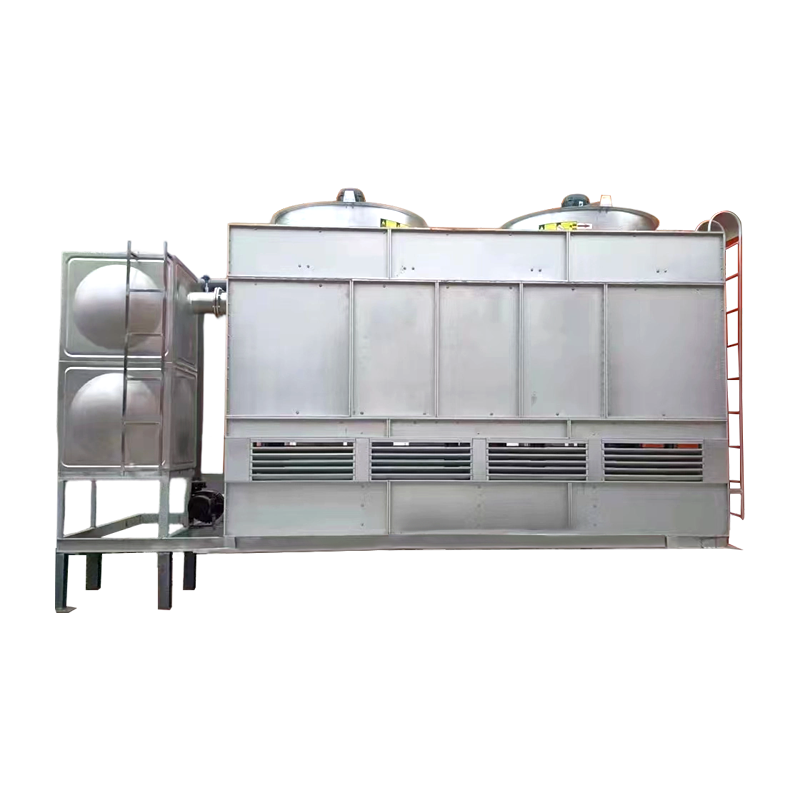 DBN Series Closed Circuit Counterflow Cooling TowerThis sealed-coil tower keeps process water isolated from air, preventing contamination and reducing chemical treatment, ideal for industries demanding water purity and efficient heat rejection.View Product →
Closed circuit systems are particularly valuable for pharmaceutical, food processing, power, and precision manufacturing applications where water quality consistency is critical.
Another design decision that affects water treatment is the basin configuration. A conventional cooling tower uses a large open basin below the fill to collect cooled water. That basin holds a significant volume of water at rest, which warms in the sun, absorbs airborne dirt, and becomes a fertile environment for algae and bacteria. A basinless design eliminates this problem. Water falls directly into a below-ground or enclosed sump with much less surface area and no prolonged stagnation, so biological growth is far easier to control.
 BL(II)W Basinless Circular Counterflow Cooling TowerThis basinless design eliminates stagnant open water, simplifying maintenance and reducing biological growth risk while offering compact, cost-effective cooling for small to medium systems.View Product →
Material selection matters just as much. FRP composite structures, hot-dip galvanized steel, and stainless steel components significantly improve the tolerance of a cooling tower to aggressive water chemistry. When the treatment program cannot fully prevent corrosive conditions, material durability is the final line of defense. If you are interested in the details, our discussion of steel structure cooling tower design considerations covers this topic in greater depth.
No matter how well the cooling tower is designed, the water treatment plan still needs to be customized to the specific site. Here are five steps we recommend to project teams:
Water treatment is not an afterthought. It is a design parameter. At Dongjie, we have spent more than two decades helping industrial customers select cooling towers that are not only thermally efficient but also practical to treat and maintain. Whether you are planning a new installation or upgrading an existing system, our engineering team can discuss how the right cooling tower design reduces long-term water treatment costs and operational risk. Share your project details with us, and we will work with you to find a solution that fits.
Related Products
A cooling tower rarely fails all at once. What often happens is quieter: the cold water temperature creeps up by a degree or two over a season, drift becomes v...
READ MOREIf you have ever asked “how does the cooling tower work?” you are not alone. At Zhejiang Dongjie, we work with engineers and plant operators who use cooling to...
READ MOREA plant engineer managing a 2 MW injection molding process was facing a familiar problem. The open cooling tower was letting suspended solids into the mold coo...
READ MOREIndustrial cooling accounts for nearly a fifth of global electricity consumption. As climate targets tighten and energy costs surge, the race toward high-effi...
READ MOREWhen a process line needs to hold a reactor at 5 °C, a chiller is the obvious choice. When the same plant needs to reject a large amount of waste heat from a c...
READ MOREA 2 MW chiller in a commercial building rejects roughly 700 kW of heat through its condenser water loop. That heat has to go somewhere. In many mid- to large-s...
READ MORE
dj@djcoolingtower.com
+86-0575-82433555 (Extension 0)
+86 130 6551 5158 Manager Zhang
