

 English
 русский
 中文简体

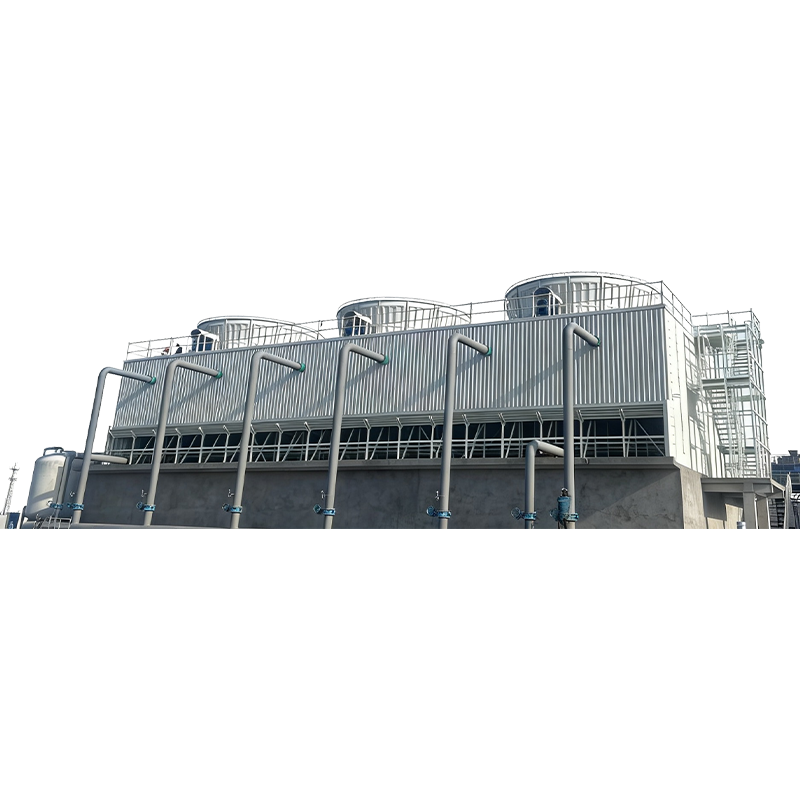
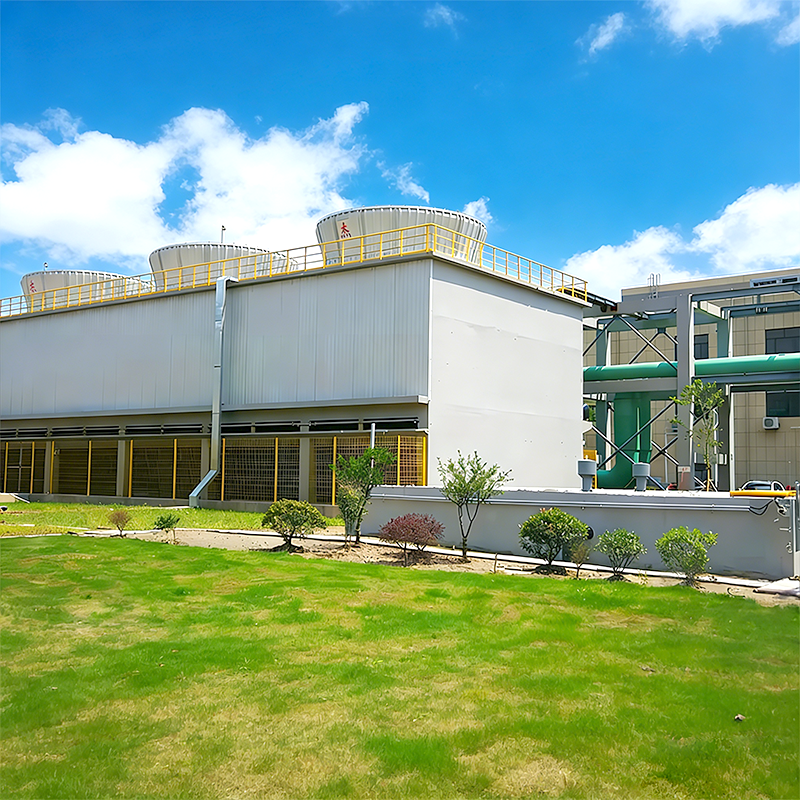
As global industrial output intensifies and sustainability mandates tighten across every major manufacturing sector, upgrading modern industrial steel structu...
READ MOREOct 02, 2026
Content
Selecting a new cooling tower is rarely about finding a single “best” technology. It is about matching the equipment to your site, your thermal load, and your maintenance team’s habits. One of the first decisions our engineers help customers make is whether to specify a crossflow or counterflow cooling tower. Both designs are proven, energy-efficient, and capable of delivering reliable industrial cooling. The differences show up in footprint, tower height, water distribution, maintenance, and performance under turndown conditions. In this article, we compare crossflow vs counterflow cooling towers and explain how to choose the right architecture for your project.
A cooling tower works by bringing hot water into direct contact with air and evaporating a small portion of that water to remove heat. The direction of air relative to the falling water is what separates crossflow and counterflow. In a crossflow tower, air travels horizontally across the falling water, entering through the sides of the tower and moving perpendicular to the water stream. In a counterflow tower, air is drawn or pushed vertically upward, moving directly against the downward falling water.
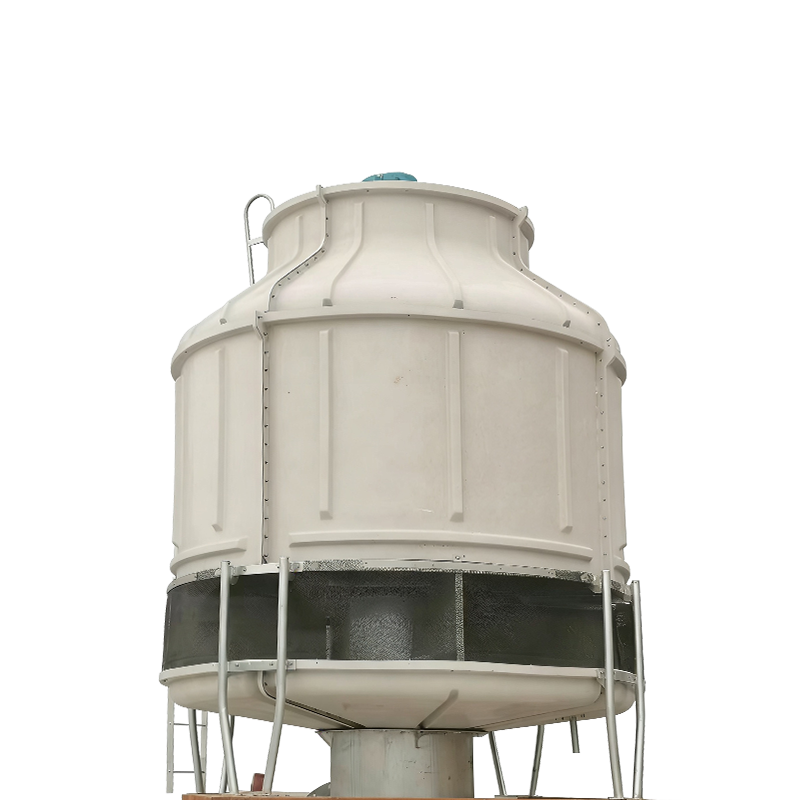
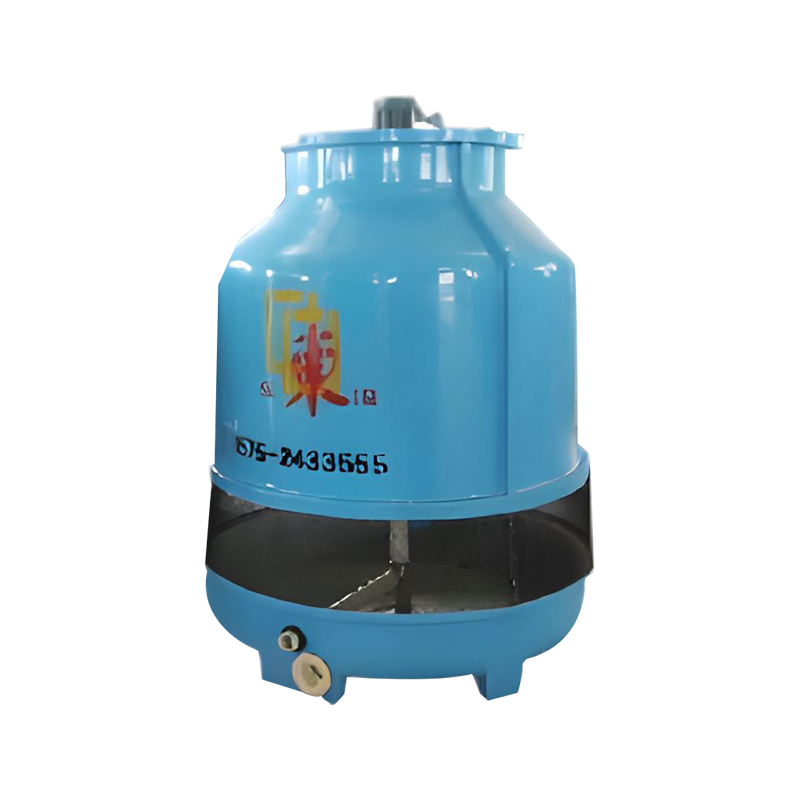
Counterflow towers rely on pressurized spray nozzles to distribute hot water evenly over the top of the fill. As the water falls, the air rises through the same fill, creating a counter-current exchange that provides excellent thermal performance in a relatively small footprint. This is why many heavy industrial projects, especially those with tight equipment areas, favor counterflow. Our industrial circular counterflow series is a common choice for that reason.
 Industrial Circular Counterflow Cooling Tower (BLS(II)J Series)1. Attractive Appearance: The tower body is made of high-quality fiberglass, with the surface gel coat using imported raw materials. External connecting standard parts...View Product →
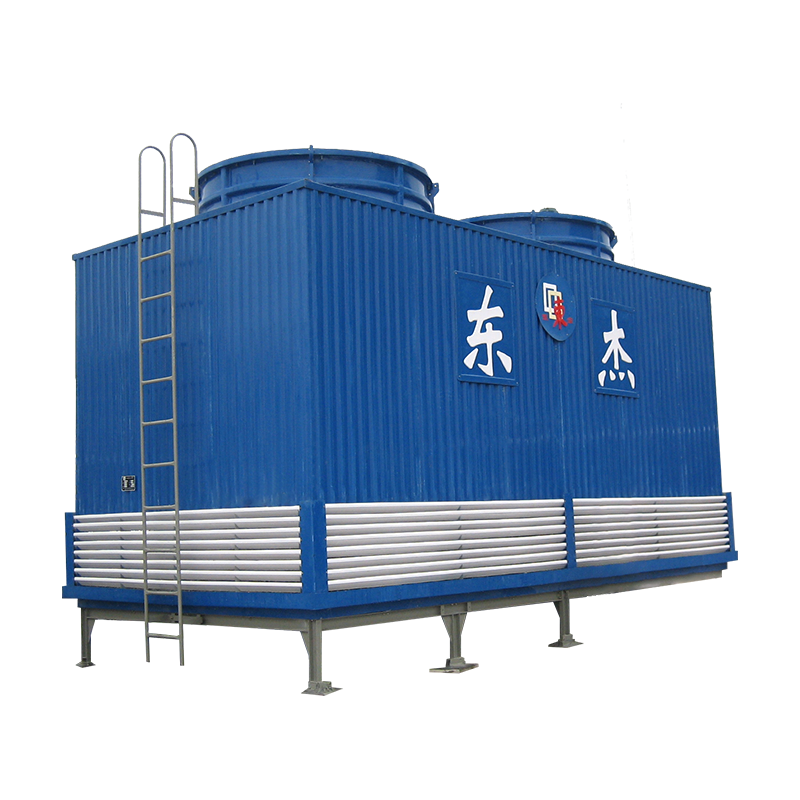
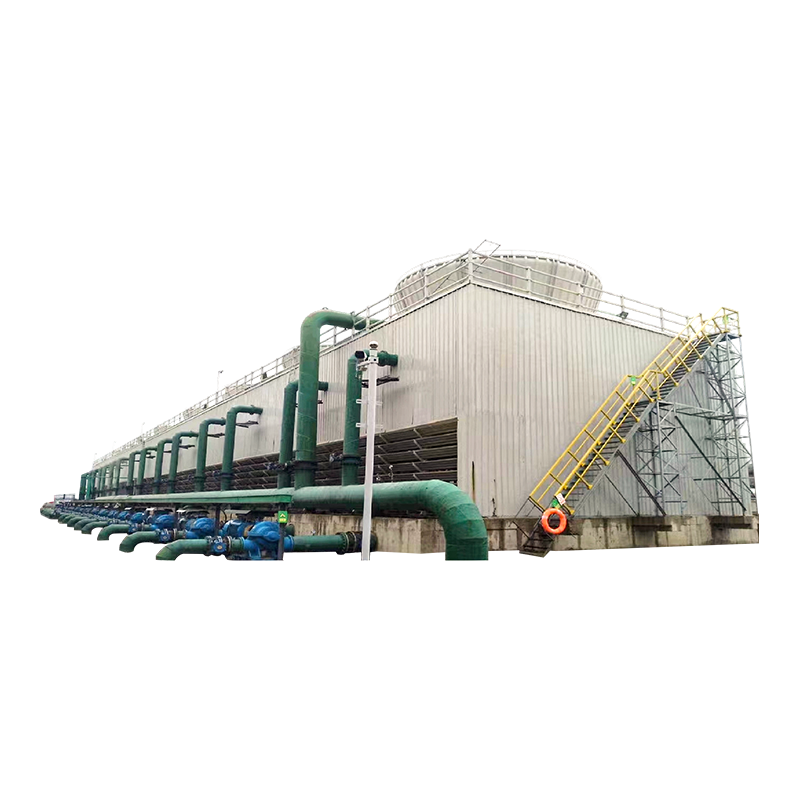
Crossflow towers use a gravity hot water basin above the fill. Water flows from the basin through orifices or low-pressure nozzles and falls through the fill while air is pulled horizontally through the fill from the tower’s sides. Because the water distribution is open and gravity-driven, crossflow towers are easy to inspect, clean, and service. Their wider basin also allows excellent turndown, making crossflow popular in HVAC systems and process plants that operate at varying loads. Our rectangular crossflow FRP composite cooling tower is one example of this design.
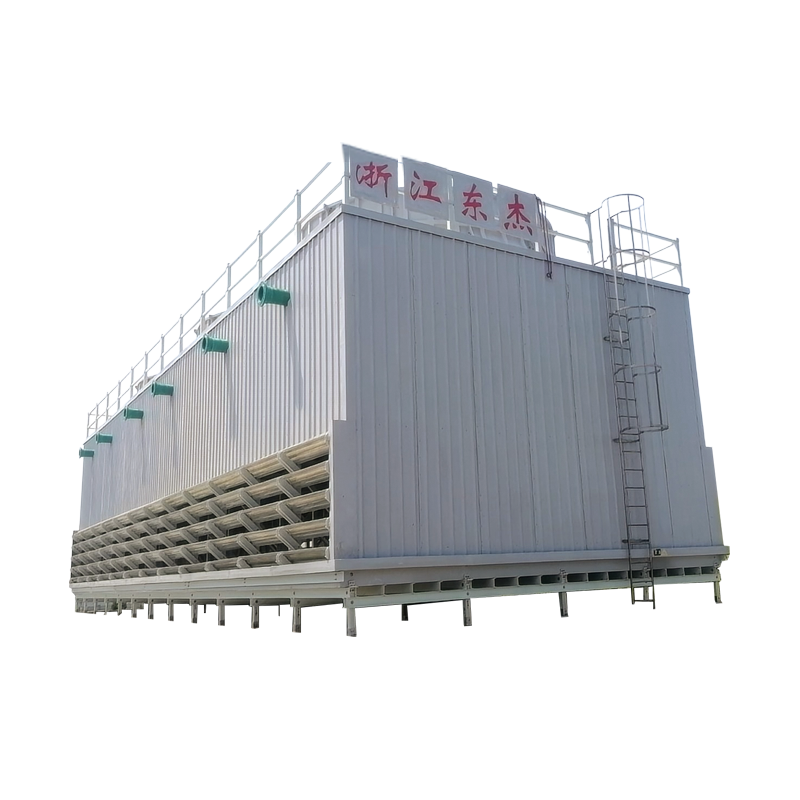 Rectangular Crossflow FRP Composite Cooling Tower (DHV Series)1. The lightweight and high-strength ratio is 20-50 times that of steel. In the design, the stiffness index is used to control the frame structure, which provides suff...View Product →
Before digging into details, it helps to see the two designs side by side. The table below summarizes the operational characteristics that most often influence equipment selection.
| Characteristic | Crossflow | Counterflow |
|---|---|---|
| Airflow direction | Horizontal, perpendicular to falling water | Vertical, opposite to falling water |
| Typical footprint | Wider and lower in height | More compact ground area, taller |
| Water distribution | Gravity distribution through open basin | Pressurized spray nozzles |
| Turndown capability | Excellent, especially at low flow | Good, but requires careful nozzle sizing |
| Maintenance access | Easier access to distribution system | More complex, often internal nozzle access |
| Heat transfer efficiency | Very good with even airflow | Excellent due to counter-current flow |
| Typical applications | HVAC, commercial, modular plants | Power, petrochemical, heavy industry |
Maintenance is often the silent factor in tower selection. Crossflow towers are loved by plant operators because the hot water basin sits above the fill and is accessible from a walkway. Debris, algae, and scale can be removed without breaking pipe connections. The nozzles operate at low pressure, and many can be removed and cleaned quickly. Counterflow towers, in contrast, route water through pressurized headers and spray nozzles located inside the tower casing. This arrangement can reduce airborne contamination and helps keep the fill uniformly wetted, but routine nozzle inspection is more involved. If your team has strong maintenance capabilities and prefers a compact design, counterflow remains an excellent choice. If you want quick, low-cost service, crossflow often wins.
Thermal performance is where counterflow towers have a theoretical advantage. Because air and water move in opposite directions, the coldest water at the bottom of the tower contacts the most humid air first, helping the tower achieve a closer approach to the wet-bulb temperature for the same fill volume. That can translate into a smaller tower or lower fan power for a given heat duty. Crossflow towers also achieve high performance, but their efficiency depends on uniform airflow through the louvered sides and evenly distributed water in the basin. In many real-world installations, the difference in energy performance is small after accounting for site-specific factors such as pump head, fan static pressure, and winter operation. Our engineers use thermal design software and test data to size both types accurately.
Physical space often decides the argument faster than any performance curve. A counterflow tower’s smaller footprint makes it attractive for rooftop placements, retrofit projects, or sites where real estate is expensive. The extra height is useful when you can integrate the tower into a structural steel frame. A crossflow tower offers a low silhouette and a wider footprint, which can be easier to screen architecturally and simpler to anchor in high-wind regions. Crossflow design also allows multiple cells to be arranged in long rows, matching low-flow operating modes without excessive partial-cell cycling. Before choosing, we always recommend a detailed layout drawing that accounts for adjacent structures, prevailing winds, and maintenance clearances.
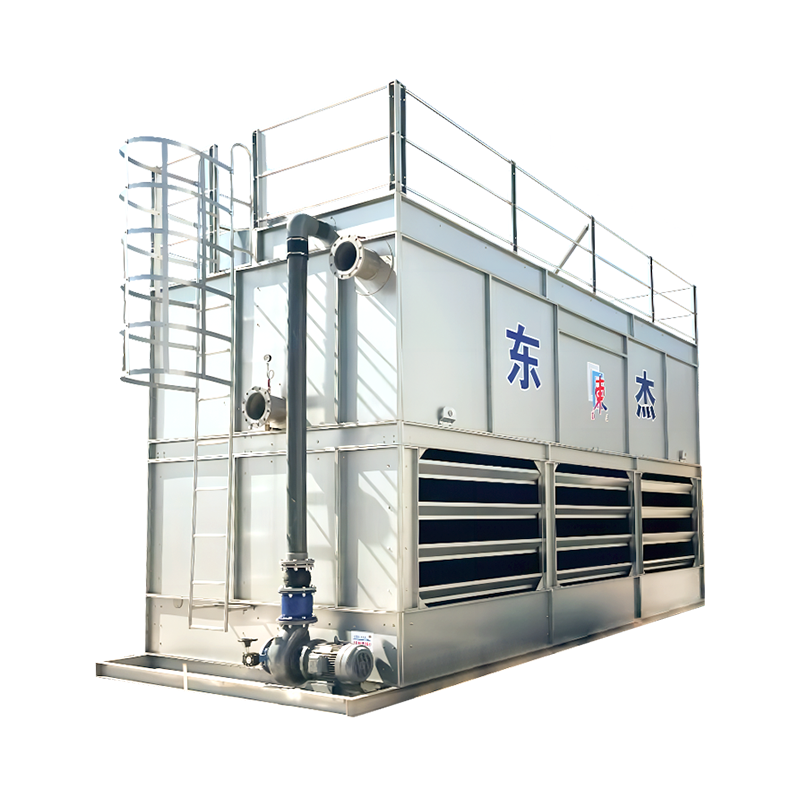
Once you choose crossflow or counterflow, the next level of specification is whether the tower should be open or closed-circuit. Open towers are efficient and widely used, but they expose process water to the atmosphere. Closed-circuit towers keep the process fluid in a coil and use a secondary water loop for evaporative cooling, protecting the fluid from contamination and making glycol or other sensitive liquids easier to manage. Both airflow patterns are available in closed-circuit form. For applications that rely on gravity water distribution and easy service access, our DM series closed-circuit crossflow tower is a good match.
 Closed Circuit Crossflow Cooling Tower (DM Series)1. Adopting a composite flow (also known as mixed flow)/cross flow cooling method, the float rate is extremely low - the internal space is large, making maintenance ve...View Product →
There is no universal winner, but there are a few rules of thumb we have developed over years of projects. Choose crossflow when your site allows a wider footprint, when maintenance simplicity is a priority, and when your load profile benefits from excellent turndown. Choose counterflow when your real estate is tight, when the tower height is not a constraint, and when you need the most compact heat transfer package. For winter operation, crossflow towers require attention to basin ice in cold climates, while counterflow towers need careful fan and water balancing. A complete selection should be based on the actual thermal duty, wet-bulb design, water quality, and local code.
We usually ask customers to compare three points:
For a closer look at how steel structure towers can influence your choice, see our guide on steel structure cooling tower configurations.
At Zhejiang Dongjie Cooling Tower, we manufacture both crossflow and counterflow towers across a wide range of materials, including FRP composite, steel, and concrete. Our engineering team is happy to review your process loads, site constraints, and maintenance preferences before recommending a design. Whether you choose crossflow or counterflow, the right answer is the one that delivers reliable performance over the life of your plant.
Related Products
As global industrial output intensifies and sustainability mandates tighten across every major manufacturing sector, upgrading modern industrial steel structu...
READ MORESteel Structure Cooling Towers Outperform Traditional Concrete in Modern Industrial Applications Steel structure cooling towers are the preferred choice for mo...
READ MOREIndustrial facilities that rely on continuous thermal processes, from power generation to chemical manufacturing to large scale HVAC systems, depend heavily on...
READ MOREIndustrial cooling is among the largest consumers of energy and water in the global manufacturing economy. Chillers, cooling towers, heat exchangers, and proc...
READ MOREWhen a process line needs to hold a reactor at 5 °C, a chiller is the obvious choice. When the same plant needs to reject a large amount of waste heat from a c...
READ MOREIndustrial cooling accounts for nearly a fifth of global electricity consumption. As climate targets tighten and energy costs surge, the race toward high-effi...
READ MORE
dj@djcoolingtower.com
+86-0575-82433555 (Extension 0)
+86 130 6551 5158 Manager Zhang
