

 English
 русский
 中文简体

Industrial facilities, commercial buildings, and power generation plants all share a common operational challenge, the need to efficiently remove excess heat g...
READ MOREOct 23, 2026
Content
Cooling towers are essential to heat rejection in industrial plants and HVAC systems, but they are also central to the conversation about Legionnaires’ disease. The very water that keeps a facility operating can, when conditions are right, support the growth of Legionella bacteria. For plant managers, engineers, and maintenance teams, understanding the connection between Legionnaires’ disease and cooling towers is more than a regulatory exercise — it is an important part of protecting people and ensuring reliable operations.
Legionella bacteria occur naturally in freshwater environments. When water enters a cooling tower, it can carry the bacteria into the system. Cooling towers typically hold a large volume of recirculating water, expose that water to ambient dust and airborne material, and run at temperatures that can accelerate microbial growth. When the water temperature stays in the 20°C to 45°C range, and nutrients such as sediment, algae, or biofilm are present, Legionella can multiply quickly.
This does not mean every tower will become a problem. It does mean every tower should be treated as a potential amplification source. Public health investigations have repeatedly traced large outbreaks back to contaminated cooling tower plumes, which is why industry guidance and building regulations now pay so much attention to cooling water management.
Transmission begins with the aerosol that a cooling tower produces. As air moves through the tower, small water droplets become entrained in the air stream. Drift eliminators capture most of these, but fine droplets can still leave the unit. If Legionella colonizes the wetted surfaces, contaminated particles can enter the droplets and travel beyond the tower footprint.
When people inhale these droplets, they may develop Legionnaires’ disease, a severe pneumonia, or the milder flu-like illness known as Pontiac fever. Wind direction, the position of nearby air intakes, and the height and speed of the discharge plume all influence how far the aerosol travels. Designers can reduce exposure by choosing efficient drift eliminators, controlling plume discharge, and locating towers away from occupied outdoor areas and building intakes wherever possible.
Several factors combine to create an environment where Legionella can survive and reproduce. Recognizing them is the first stage of an effective control program.
| Factor | Why it matters | Practical control |
|---|---|---|
| Water temperature between 20°C and 45°C | Supports rapid bacterial multiplication | Use weather-responsive controls and keep water moving |
| Stagnant zones and dead legs | Allow bacteria to settle and grow undisturbed | Eliminate dead ends and flush idle lines |
| Biofilm, sediment, and scale | Protect Legionella from disinfectants | Clean wetted surfaces and remove debris regularly |
| Inadequate biocide dosing | Lets Legionella rebound between treatments | Maintain steady residual and verify with testing |
| Excessive drift | Carries contaminated droplets to people | Inspect drift eliminators and check water distribution |
These factors are interrelated. Temperature alone cannot always be controlled, so cleaning and water chemistry carry more of the burden. A tower that is difficult to access or impossible to clean thoroughly will undermine even the best biocide program.
A reliable Legionella control program follows a structured schedule. Based on widely accepted industry practice, the basics include the following.
Trends matter more than single readings. Documented maintenance also makes it easier to respond quickly when a test result exceeds the action limit.
Several recognized frameworks describe how to manage Legionella risk in building water systems. Standards such as ASHRAE 188 require a comprehensive water management plan based on risk assessment, control measures, monitoring, and corrective action. Health departments and regulatory authorities in many regions publish similar guidance for cooling towers. Operationally, these frameworks all point to the same practical priorities: keep water clean, keep it moving, control temperature where possible, and prevent human exposure to aerosols.
Written water management plans are not just paperwork. They force a facility to map every pipe, valve, storage tank, and cooling tower, then match that map with the right monitoring points and response thresholds. For a cooling tower, that plan should cover the drift eliminators, the basin, the fill, and all connected water lines. A clear plan gives everyone the same playbook when the system needs attention.
The stage where risk is most effectively reduced is before installation. A cooling tower built from corrosion-resistant materials — such as FRP composite panels and stainless steel fasteners — provides fewer surfaces for biofilm to cling to and is easier to keep clean over the long term. Similarly, a design with smooth, well-draining surfaces gives the water treatment team a better chance of removing deposits before they become a problem.
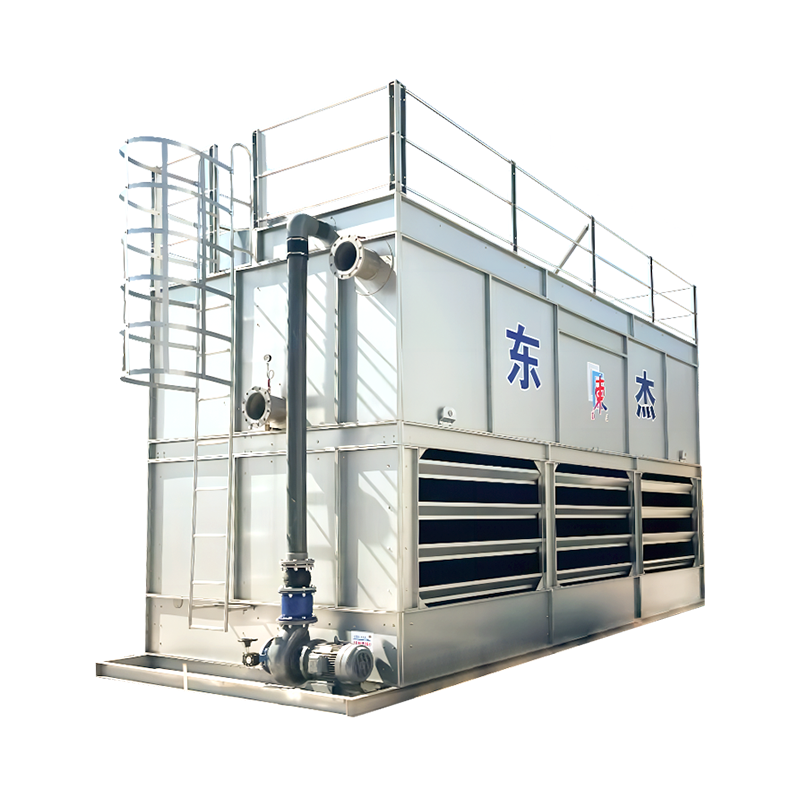
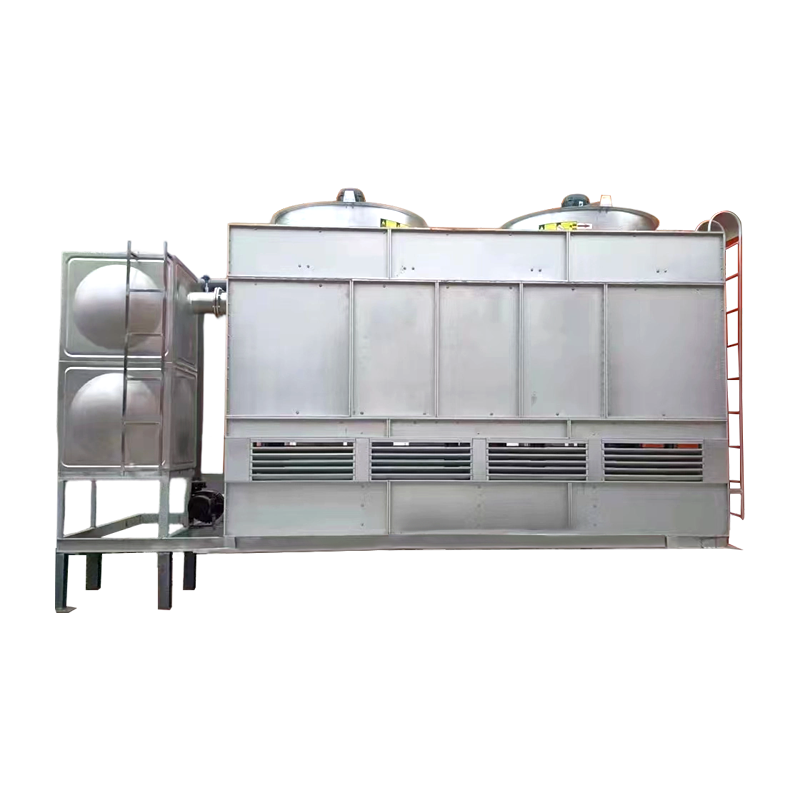 东捷DBN系列闭式逆流冷却塔该闭式冷却塔使工艺水在密封盘管内循环,避免与外部空气接触,从而降低污染风险,适合对水质要求较高的工业场景。View Product →
For applications where the process fluid should be protected from outside air, closed-circuit cooling towers offer a meaningful advantage. The process water stays inside a sealed coil, so it is not directly exposed to airborne dust, debris, or other potential contaminants. The external spray water still requires proper treatment, but the closed loop reduces the risk of process-side contamination and gives operators more predictable conditions.
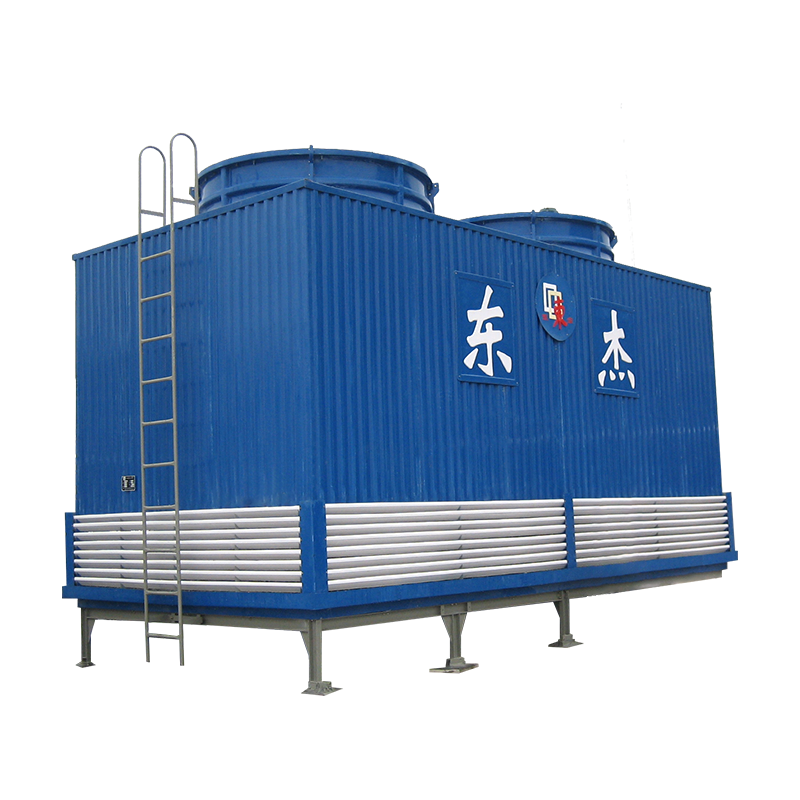
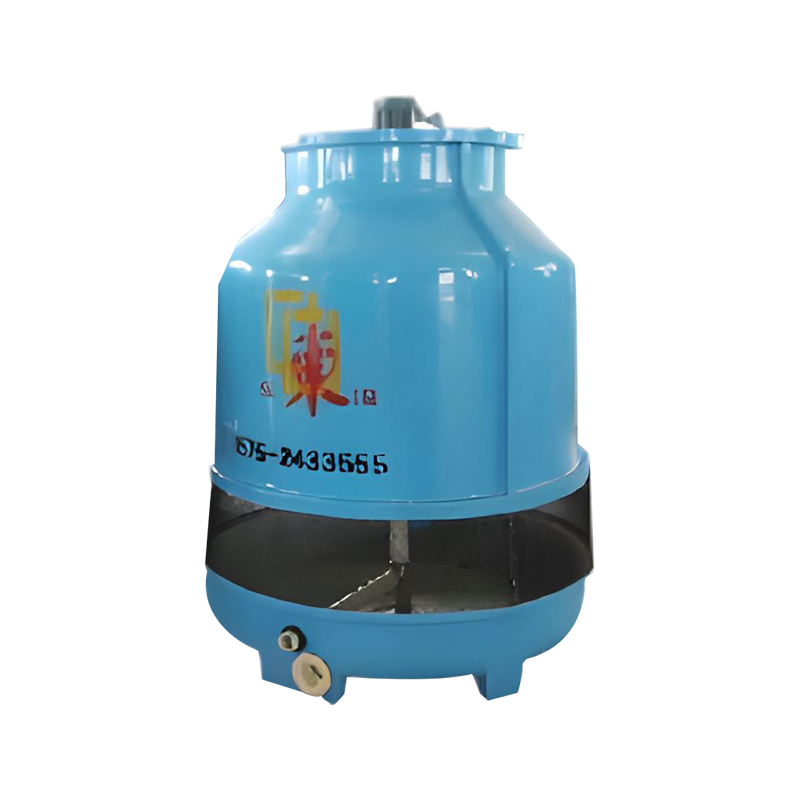 东捷BLS(II)J系列圆形逆流冷却塔该开放式冷却塔在维护性方面设计周到,具备宽敞检修口和可排空水盘,便于日常检查与清洁,有助于及早发现并处理问题。View Product →
For open evaporative systems, maintainability is the central design quality. An industrial tower with wide access openings, a fully drainable basin, and easily inspectable fill will be far safer in practice than a compact unit with cramped internal spaces. When the maintenance crew can see inside and reach critical surfaces, small issues are caught early. If you are planning an equipment purchase, the technical indicators to review before purchasing a cooling tower should include water management and serviceability, not just thermal capacity.
Another point to consider is the amount of surface area where water and air meet. Evaporative cooling works by evaporating water, but this also means airborne material can enter the system. The right nozzle placement, fill geometry, and baffle arrangement help distribute water evenly and reduce wet, poorly wetted pockets where bacteria can settle.
In our own work across power, petrochemical, metallurgy, HVAC, and renewable energy projects, the same principle keeps surfacing: a system that is easy to inspect and service is the one that stays cleanest. We have spent years refining details that reduce the effort needed for good maintenance — access doors that open correctly, fill packs that can be handled, basins that drain completely. These may seem like small points, but they have a direct effect on whether water treatment staff stay ahead of biofilm and sediment.
At the same time, we are careful not to present equipment design as a substitute for a sound water treatment program. The tower and the treatment plan work together. A thoughtful supplier will discuss both. From the factory floor to the project site, we have seen how a little extra thought at the design phase can save years of aggravation. We bring this hands-on perspective to every project, and it is reflected in the approach we take across our product range.
Legionnaires’ disease and cooling towers will remain a serious conversation because the risk is real. However, with a combination of good design, regular maintenance, and honest tracking, the risk is manageable. If you are planning a new cooling tower or reviewing an existing installation, take the time to look at the unit from the water treatment operator’s point of view. That perspective will guide you toward an asset that is both efficient and safe over its full service life.
Related Products
Industrial facilities, commercial buildings, and power generation plants all share a common operational challenge, the need to efficiently remove excess heat g...
READ MOREIndustrial cooling accounts for nearly a fifth of global electricity consumption. As climate targets tighten and energy costs surge, the race toward high-effi...
READ MOREWhen purchasing an FRP (Fiber Reinforced Plastic) Composite Cooling Tower, the most critical technical indicators to evaluate are: thermal performance (cooling...
READ MOREIndustrial facilities that rely on continuous thermal processes, from power generation to chemical manufacturing to large scale HVAC systems, depend heavily on...
READ MOREThe core difference between FRP (Fiberglass Reinforced Plastic) and concrete cooling towers comes down to weight, lifespan, and cost structure. FRP towers are ...
READ MOREA cooling tower rarely fails all at once. What often happens is quieter: the cold water temperature creeps up by a degree or two over a season, drift becomes v...
READ MORE
dj@djcoolingtower.com
+86-0575-82433555 (Extension 0)
+86 130 6551 5158 Manager Zhang
